A couple weeks ago I overheard a woman sharing how she found the “secret” to peeling hard-cooked eggs. Her method was carefully poking a hole in the shell before cooking.
Actually, this is just one of many of the “theories” on this topic I’ve heard over the years. These have included cooking with salt or baking soda or vinegar to the pan. Carefully timing the cooking process. Chilling with ice…or not chilling with ice. More recently many people swear by using their instant pressure pots. These theories go on-and-on.
The NC Egg Association (ncegg.org) has some word of caution about the hole-the-shell method. They say that piercing the shell before cooking may allow some air to escape and some water to seep into the egg during cooking, which may make peeling easier. However, piercing often produces hairline cracks in the shell, making the egg more vulnerable to bacteria. For this reason, piercing is not recommended.
So, is there a good answer to easily peeling egg shells?
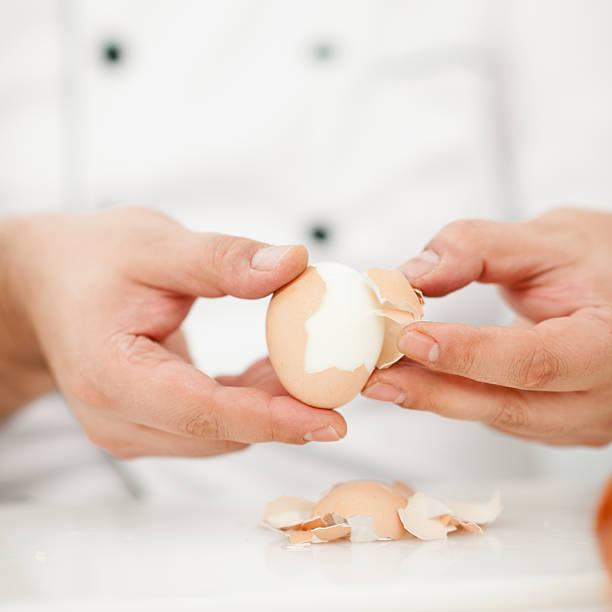
The American Egg Board (incredibleegg.org) says the “key” to easily peeled hard-cooked egg is to buy them a week to 10 days before you want to cook them. These “older” eggs have had time to take in air through the shell. This helps separate the membranes from the shell. Hard-cooked eggs are also easier to peel right after cooling because the egg to contracts slightly in the shell. They recommend peeling a hard-cooked egg by gently tapping it on a countertop until the shell is finely crackled all over. Then roll egg between your hands to loosen shell. Starting peeling at large end, holding the egg under cold running water to help ease the shell off.
In the shell, hard-cooked eggs can be refrigerated safely up to one week. Once peeled they recommend eating the same day for best quality. They also note that eggs are perishable and must be stored in the refrigerator at 41 degrees or less. Many factors can affect how long eggs last. When properly handled and stored, eggs rarely spoil. However, if you keep them too long, they are likely to dry up. If you’ve ever hard-cooked eggs that you’ve had for a long time you may note irregular shapes—this is caused by air pockets that have formed inside the shells caused by evaporation. Raw whole eggs (in the shell) will keep good quality for 4-5 weeks from the pack date or about three weeks from purchase.
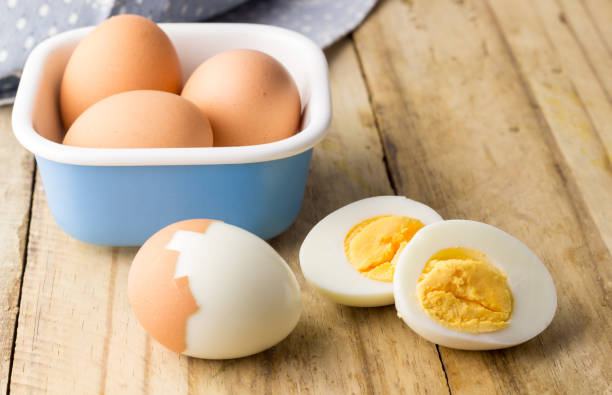
You may note that I’ve been calling them “hard-cooked” instead of “hard-boiled”. It’s just a pet peeve of mine. When making a good hard-cooked egg—the egg should never actually be boiled. Boiling tends to overcook the egg which leads to rubbery whites and that ugly green ring around the yolk. This ring is the result of a reaction between the sulfur in the white and iron in the yolk, which interact when combined with high heat and over cooking.
The American Egg Board offers these instructions for easily Hard Cooking Eggs on the Stove Top:
Place uncooked eggs in a single layer on the bottom of a saucepan.
Add cold water until the eggs are covered with about an inch of water.
Heat to boiling. Turn off the heat and cover for 12-18 minutes. Cooking times vary based on the size of the eggs - 9 minutes for medium eggs, 12 minutes for large and 15 minutes for extra-large.
Remove saucepan from heat and drain.
Submerge cooked eggs in an ice bath for five minutes to cool eggs.
Drain and dry eggs.
Store in the refrigerator.
There is one exception to these rules and that’s when a hurricane is on the way.
Hard-cook eggs and air cool them before the storm hits…and then you can keep the
eggs at room temperature should you lose refrigeration. Simply eliminate steps 5
through 7 from the above instructions and allow the eggs to air cool. Hard-cooked
eggs that are air cooled will not support the growth of pathogens. However, they will
eventually spoil, so use within one week.
Syracuse is a Family and Consumer Science team member and can be reached at N.C. Cooperative Extension, Brunswick County Center 910-253-2610 or by email at Cheryle_Syracuse@ncsu.edu