It’s time for some more MythBusters from the Partnership for Food Safety Education (PSFE). This is a group of food manufacturers, governmental food safety agencies, grocery stores, consumers and communication folks that have joined together to develop educational programs to reduce the risk of foodborne illness in homes. They have lots great food safety tips based on science. Their website FightBac includes an entire section of Food Safety MythBusters. Last month I shared some related to holiday cooking.
Food safety myths often originate from misunderstood science, misinformation on social media or even family traditions (this is how we’ve always done it). These MythBusters are designed to help debunk some of these common home food safety myths. This time…. Microwave MythBusters.
Myth:
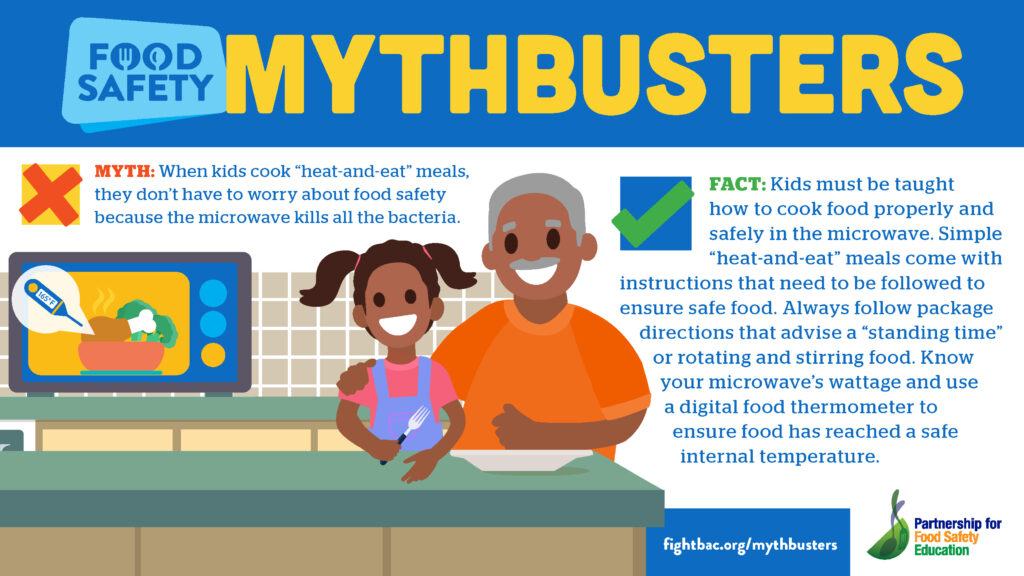
When kids cook “heat-and-eat” meals, they don’t have to worry about food safety because the microwave kills all the bacteria.
BUSTED: Kids must be taught how to cook food properly and safely in the microwave. Simple “heat-and-eat” meals come with instructions that need to be followed to ensure safe food. Always follow package instructions that advise a “standing time” and/or rotating and stirring food. Know your microwave’s wattage. The higher the wattage the faster food will cook. If you have a small microwave with a smaller wattage, you may need to add additional time to complete cooking. Use a food thermometer to ensure food has reached a safe internal temperature. Microwaves themselves do not kill bacteria. It is the heat created in the food that can destroy pathogens.
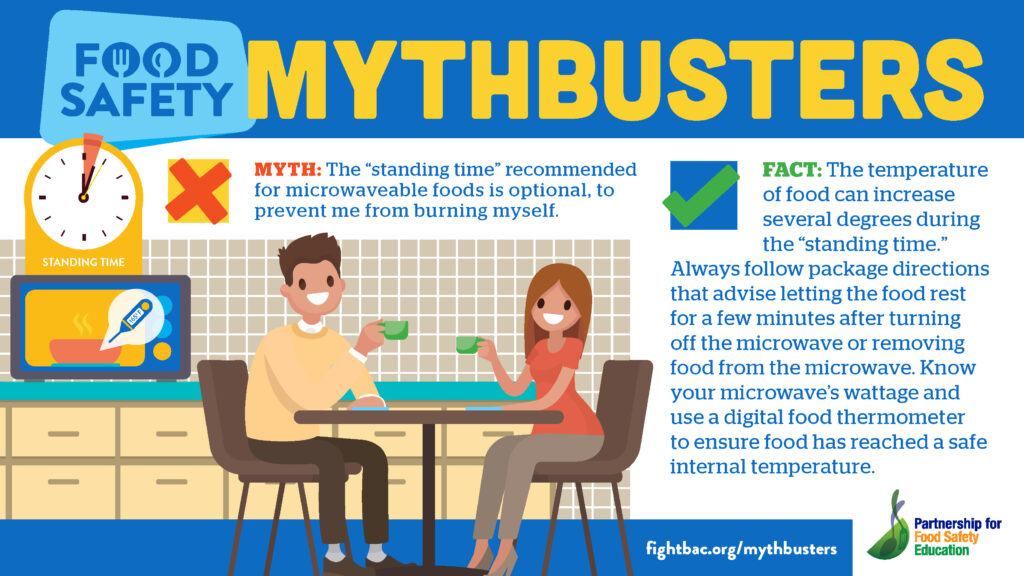
Myth: The “standing time” recommended for microwavable foods is optional, to prevent me from burning myself.
BUSTED: Always follow package directions that advise letting the food rest for a few minutes before removing from the oven or serving the food. Microwaves can cook unevenly because food may be shaped irregularly or vary in thickness, leaving cold spots in the food where harmful bacteria can survive. Standing time allows for the temperatures to equalize throughout the entire food. The temperature of food can increase several degrees during the “standing time.”
Stirring is important too when cooking in the microwave. The microwaves themselves can only penetrate food to a depth of ¾ to 1½ inches. Heat spreads through conduction to the other parts of the food. So, the inside of the food is the slowest to cook, when food is stirred this helps bring the hotter outside food into the center and the cooler center food out. Stirring helps to equalizes temperature in food and shortens cooking time.
Myth: Because microwaves ovens don’t have coils or burners there isn’t a chance of fire or burning, so it is safe for children to use.
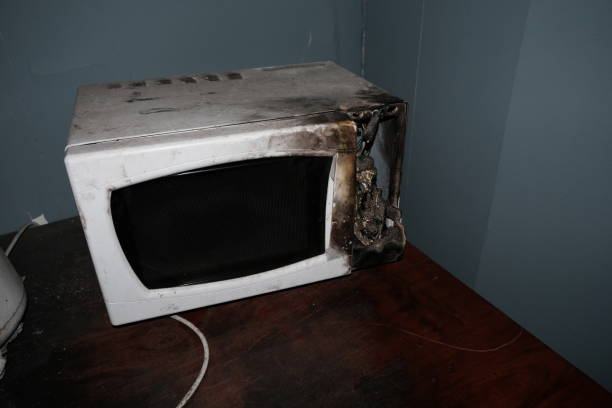
BUSTED: Food safety isn’t the only concern with microwaves. While infrequent, fires can happen in a microwave. These are usually caused by overheating or cooking too long. Foods with low moisture do not microwave well, they tend to quickly dry out and could catch on fire. This is why microwave popcorn tends to burn if left in the microwave too long. Also, take care with processes such as drying herbs, because as the moisture evaporates from the herbs they do get dry and brittle and can catch on fire. If doing this type of microwaving, pay close attention to what’s happening. Don’t leave the appliance unattended.
During COVID there were photos on the internet of people trying to sanitize masks in microwave ovens. Microwaves cannot kill bacteria or viruses. This practice usually led to the masks drying out and fires starting.
If your microwave catches on fire, immediately turn it off. This turns off the fan that could feed oxygen to the fire. Unplug if possible. Keep the door shut to help suffocate the fire.
If this doesn’t work call the fire department.
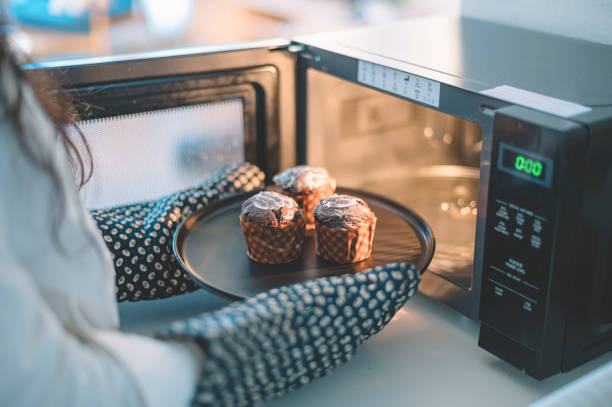
Burns are another safety concern. Even specially developed microwave utensils can become hot, because the heat comes from the food, not microwave energy—be sure to have pot holders handy.
Syracuse is a Family and Consumer Science team member and can be reached at N.C. Cooperative Extension, Brunswick County Center 910-253-2610 or by email at clsyracu@ncsu.edu