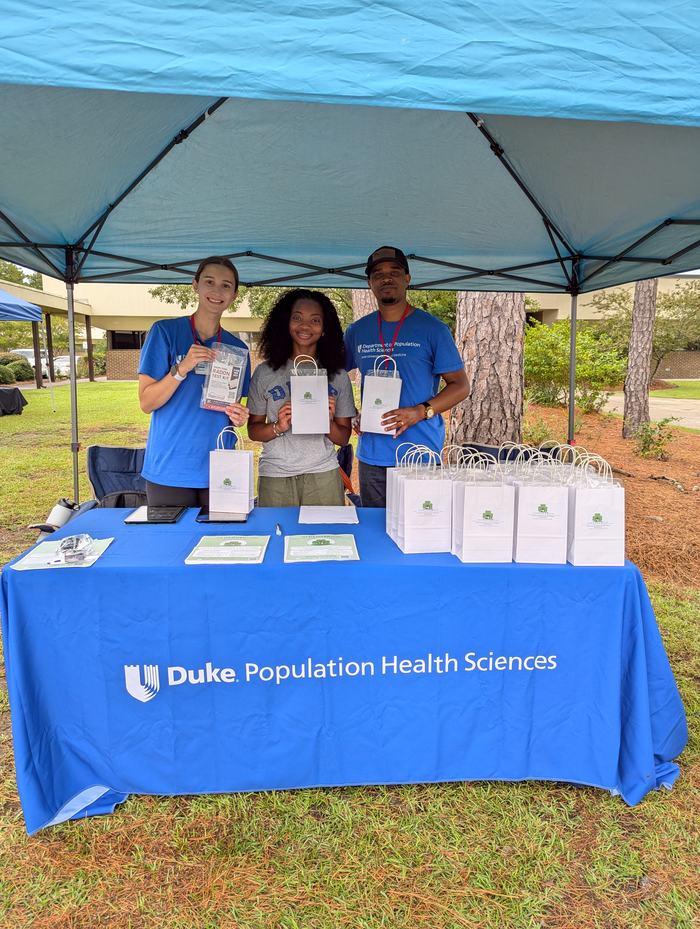
Photo info: (from left to right) are Mary Srivastava, Research Assistant; Oana Djibom, Undergraduate Intern; and Jules Iradukunda, Research Assistant with the CLOVER project.
At the recent Brunswick County Health and Wellness Fair held at the Government Center, I stopped by an exhibit about the CLOVER Study. This stands for Climate Impact on Lung Cancer via Exposure to Radon and is a research study by a group at Duke University.This team from the Department of Population Health Sciences is looking at how radon exposure - worsened by climate-related changes - affects lung cancer outcomes in North Carolina. They are particularly looking at communities that have been historically underrepresented in environmental health research.
I was surprised to see them here in Brunswick County, because I didn’t think radon was a big problem in our area. The team confirmed that although Brunswick County has a lower average radon risk compared to other regions in North Carolina, radon levels can vary significantly from home to home and area to area due to factors like soil composition, building materials, and ventilation. Even homes located next to each other can have drastically different radon concentrations.
Radon is a radioactive gas that forms naturally through the breakdown of uranium in soil and rock. It can seep into homes through cracks in foundations, basements, or well water - and it has no color, smell, or taste. Exposure to radon increases over time, especially in poorly ventilated or older homes. Children are especially vulnerable; their risk is twice as high as adults when exposed to the same levels. Because it is a naturally occurring gas, complete elimination of radon is not possible, however taking action to reduce your exposure to radon can be done.
Why even think about radon? Radon accounts for 15% of the lung cancer cases in the United States. This makes radon the seconding leading cause of lung cancer after smoking and the leading cause of lung cancer among nonsmokers. Because radon and tobacco smoke have a synergistic effect, smokers exposed to radon are 25 times more likely to develop lung cancer than non-smokers.
Even though we haven’t thought much about radon in this part of NC, climate change may be increasing our risk of radon exposure through various pathways. Higher temperatures and longer AC use reduce indoor-outdoor air exchange, allows radon concentrations to accumulate in indoor air. Heavy rainfall and flooding can push more radon from the soil into homes. Furthermore, due to high temperatures, people are spending more time indoors, therefore increasing their exposure to radon concentrations.
Because radon is invisible and odorless, the only way to know your home’s radon level is to test. Radon levels are measured in picocuries per liter (pCi/L), a unit that reflects the radioactive decay of radon gas particles in air. The higher the pCi/L, the greater the concentration of radioactive radon gas in the air.
The EPA recommends mediation if indoor radon levels are at or above 4.0 pCi/L. The good news is that the highest tested level of radon found in Brunswick County so far was 3.6 pCi/L. However, this measurement should not be used to predict whether your home will have elevated radon levels or not. Radon levels are site specific and the only way to know the radon level in a building is to test it.
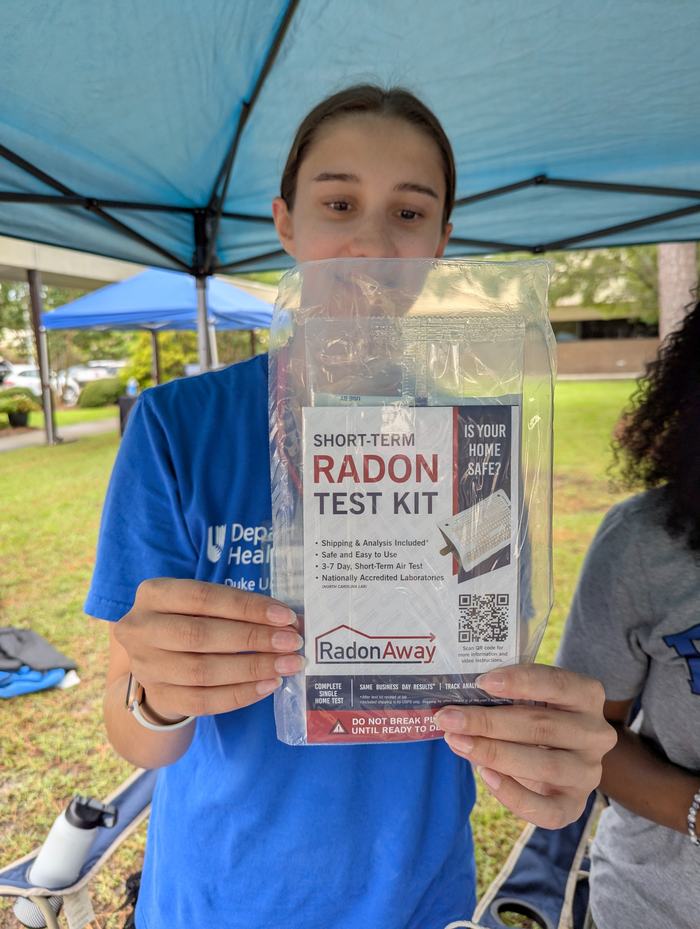
To measure radon in homes, short-term test kits (typically taking 3–7 days) are placed in the lowest livable level of a home, away from drafts, windows, and exterior walls. These kits absorb airborne particles and are then mailed to a lab for analysis. The CLOVER Study provides these kits for free to North Carolina residents.
If you’d like to get a free test, you can reach out to the folks at the CLOVER study at Duke. You must be willing to complete a radon test in your home (it’s a simple test you do yourself). Then they will have you answer a short survey about your home’s characteristics, health and risk factors. A bonus: after the test and survey are received you will get a $10 VISA card for helping with the study and you’ll get your radon test results.