Substitution is sometimes the name of the game. Perhaps you have family members coming for the holidays that are vegan or vegetarian and don’t eat animal products. Maybe it’s an allergy. Someone just doesn’t like a specific food or maybe you just ran out of something in the kitchen.
That’s how this project started. One of our office colleagues found out they were allergic to eggs. So, our Extension Master Food Volunteers went on a quest to find some substitutes for eggs---particularly in baking. What they found may help you as we move into this season of holiday baking.
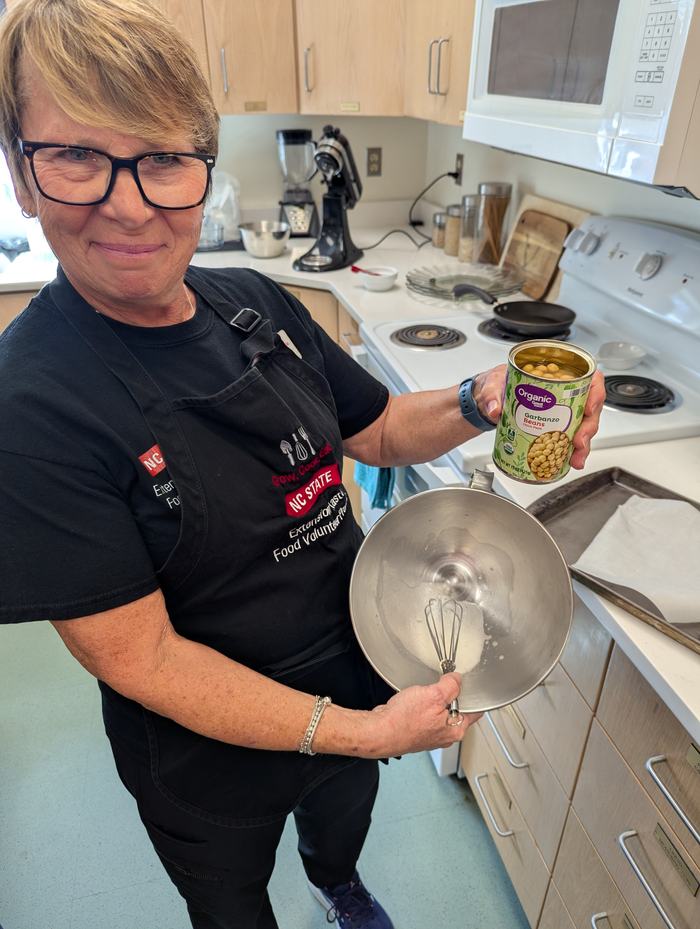
Extension Master Food Volunteer Lori Van Horn from Sunset Beach uses aquafaba as an egg substitute
When using a substitute for eggs you first have to understand the roles eggs play in recipes. They usually have three jobs: they act as a binder to hold the recipe together, provide moisture and/or act as a leavening agent to help the food rise. Their role in the recipe determines replacement options. One egg is roughly 1/4 cup (four tablespoons or two ounces) so that volume needs to be replaced in the recipe.
When the egg is used as a binder or to provide moisture in baked products like cakes,
cupcakes, muffins, and brownies, good substitutes can be ripe bananas, applesauce (or other pureed fruit or vegetable), yogurt or nut butters. For each large egg in the recipe use:
¼ cup mashed ripe banana (gives a definite banana flavor)
¼ cup unsweetened applesauce or fruit puree (results in a sweeter, chewer,
denser product with a slight fruit flavor)
3 tablespoons peanut or any nut butter (slight nut flavor and obvious allergy
concern)
¼ to ½ cup of plain or Greek dairy or non-dairy yogurt
¼ cup mashed avocado (works great for adding moisture but will add flavor,
tends to work good with chocolate)
¼ cup vegetable purees such as pumpkin, sweet potato, mashed beans or
mashed tofu work to add moisture but no leavening and may add flavors.
For pancakes, quick breads and cakes where you need some leavening to give the
product texture and lift, use flax seeds, chia seeds or baking powder with oil. This is
where it begins to get tricky. All of these substitutes tend to produce a denser baked
product.
Flax Seeds: Mix one tablespoon ground flax seeds with three tablespoons hot
water (allow to set for five minutes to thicken) equals one large egg.
Chia Seeds: One tablespoon of chia seeds plus three tablespoons hot water
(allow two set to thicken before use) equals one large egg. The chia seeds add
texture and a bit of crunch.
Unflavored Carbonated Water: ¼ cup unflavored carbonated water. This works
as a leavening agent but it does not work as a binding agent.
Baking Powder and Oil: 1 ½ tablespoons vegetable oil plus 1 ½ tablespoons
water and one teaspoon baking powder. This works as a leavening agent but will not work as a binding agent.
Another non-meat egg substitute that you may not have heard of before is aquafaba.
It’s the liquid from cooked or canned chickpeas or garbanzo beans. Three tablespoons of aquafaba equals one egg. Whip the aquafaba until it forms fluffy foam.
Extension Master Food Volunteers (l to r) Lori Van Horn from Sunset Beach; Jane Kulesza from Oak Island; and Terry Amrhein from Sunset Beach prepare eggless cookies in the Brunswick County Extension Demonstration kitchen.
The Extension Master Food Volunteers went into the Extension Demonstration Kitchen to give some of these substitutes a try. They make small batch chocolate chip cookies using flax seed, applesauce and aquafaba.
The results: All of the cookies worked and were edible. Those made with flax and applesauce were the best. The cookies made with the aquafaba spread out a little more and tended to be crunchier. Our office staff had no problem eating all of them.
Some general rules for substituting eggs: Egg substitutes generally do not work if a recipe calls for more than 3 eggs. Pound cakes, sponge cakes, angel food cakes and churros do not turn out well with egg substitutes.
For recipes that use eggs primarily as the leavening agent, you may want to try a commercial egg replacement product.
Even when baking without eggs, the food still needs to be cooked thoroughly, especially if it contains flour. Bake all products to an internal temperature of at least 165 degrees Fahrenheit.
As with any substitutions, you may need to experiment a couple of times before you get the perfect product that you like. But hopefully these ideas can give you a starting point.
Syracuse is a Family and Consumer Science team member and can be reached at NCCooperative Extension, Brunswick County Center 910-253-2610 or by email atclsyracu@ncsu.edu