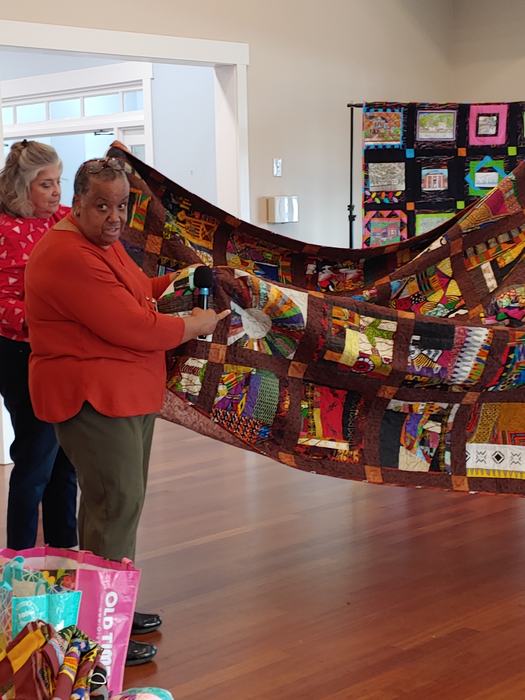
Last month I had the pleasure of attending a class on quilting sponsored by the Southport Historical Society at the Southport Community Center. The topic was "My Journey as an African American Quilter." The speaker was Marilyn Gore, a Brunswick County native, colleague, and friend.
Gore grew up in Bolivia but now lives in the Charlotte area. She attended the Brunswick County Training School where she learned to sew and began her interest in clothing and textiles. She says she made her first quilt when she was 14 years old. Gore has a BS degree from Bennett College in Greensboro and an MS from Howard University. She retired from the N.C. Cooperative Extension service after working 31 years for the Extension Service both here in NC and in Washington DC.
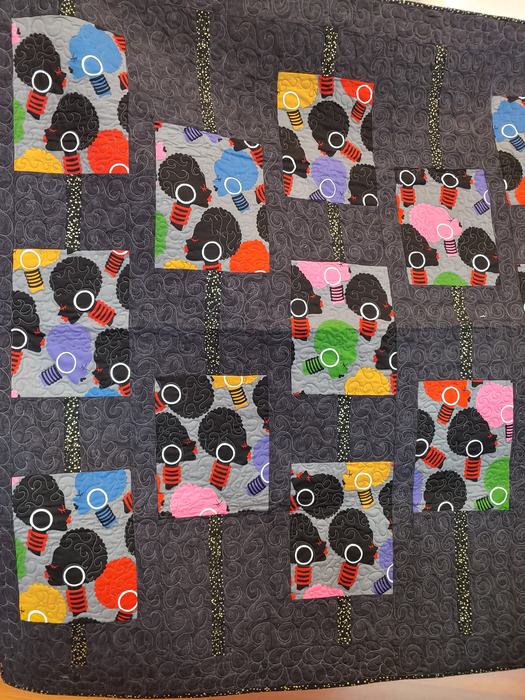
Her presentation explained the common themes found in African American Quilts. She also shared some examples of quilts that she has made that incorporate these concepts:
- Make do with fabrics you have—use scraps and leftovers
- Joyful and Bright
- Freehand Style
- Clashing Colors
- Abstract Designs
- Religious Symbols
- History of the African American people
Gore quoted the late quilt maker, Roberta Horton, saying that
African-American quilts "offer a wonderful opportunity for the average quilter to break out of the traditional Euro-American quilt-making mold and do something growing." Horton’s (and Gore’s ) quilts blend African designs and themes with American quilting traditions. The results are quilts that follow a different set of rules where improvisation replaces repetition, off-setting is preferred over matching and grids are abandoned for a vertical strip format. Their quilts possess a wonderful and exciting energy. Quilts made from scraps of African fabrics are Gore’s favorites. She says, "scraps have potential---can’t think---just do."
These quilts incorporate strips, mismatching or off-set pieces,
coping strips (pieces added to make it square), scraps, and sections---not the traditional continuous pieces of fabric.
There are few examples of early African-American quilts still available because they were well-used. Gore also shared the story of Harriet Powers, a freed slave that told stories through quilting. Power’s 1886 quilt was appliqued with pictures based on bible stories. This quilt now resides at the Smithsonian in Washington
DC.
Gore also shared stories about the Women of Gee’s Bend. This is a remote black community in Alabama. These women created hundreds of quilt masterpieces from the early 20th century and are still doing it today. These quilts transform recycled work clothes and dresses, feed sacks, and fabric remnants into sophisticated designs. The Women of Gee’s Bend and their colorful geometric quilts have been featured on US postage stamps.
If you’re interested in learning more about these African-American quilters, Gore recommended the book A Communion of the Spirits by Roland L. Freeman.
Marilyn has a home-based quilting business called Stitching and Stirring. She is dedicated to the preservation of quilts and the art of quilting with special emphasis on quilts that represent the African American culture and history.
I love the name of her company: Stitching and Stirring. I can relate to it. Marilyn and I have degrees in Home Economics (now called Family and Consumer Sciences). Over the years we both frequently told people "home economics is more than stitching and stirring"...so true. She said she always wanted to use that as the name of her business. Way to go Marilyn!
You can see some of Gore’s work and learn about her business at Stitching and Stirring.
Cheryle Syracuse wrote this article and more similar ones for the Family and Consumer Sciences Column in the Brunswick Beacon. Syracuse is an FCS team member and can be reached at N.C. Cooperative Extension, Brunswick County Center, 910.253.2610 or by email at cheryle_syracuse@ncsu.edu.